Color-Pattern-Length Model (1987)
deutsche Version
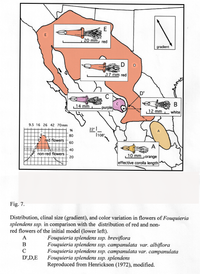
This is a very typical classical distribution of a species split here in the genus Fouqieria.
The individuals not only become gradually shorter in length from northwest to southeast, but also change their color pattern according to the above model. Such distributions can also be found in the genera Mimulus, Diplacus. There are other examples of this. Species splitting. It is not only a local but also a regional event. The driver is climate change; the forms adapt dynamically to these new circumstances (1972).
 | ThesisRB1987.pdf (7.5MB) |

